
Top 10 Hardening Oven Manufacturers for Global Buyers
Choosing the right Hardening Oven is rarely a simple purchasing exercise. Global buyers must examine temperature uniformity, furnace capacity, atmosphere control, loading methods, energy use, and after-sales support. A machine may look impressive in a brochure, yet perform poorly when production loads vary. That difference matters on a busy factory floor.
Dr. George E. Totten, a widely recognized heat-treatment authority, has described heat treatment as “both a science and an art.” This view remains practical. Operators need reliable data, but they also need experience with steel grades, part geometry, quenching behavior, and process changes. A small temperature deviation can affect hardness, distortion, or surface quality. The best manufacturers provide calibrated controls, clear maintenance guidance, documented testing, and responsive technical assistance.
This Top 10 Hardening Oven Manufacturers for Global Buyers guide compares suppliers through a practical lens. It considers engineering capability, product consistency, customization, safety features, international service, and long-term operating value. It also looks beyond polished specifications. Some manufacturers offer excellent equipment but limited regional support. Others provide strong service while lacking flexibility for unusual workloads. Buyers should reflect on these trade-offs before choosing.
No ranking can fit every factory. Production volume, material type, certification needs, and available floor space change the decision. A careful buyer should request performance records, inspect references, and clarify warranty conditions. That extra effort may feel slow. It can prevent expensive surprises later.
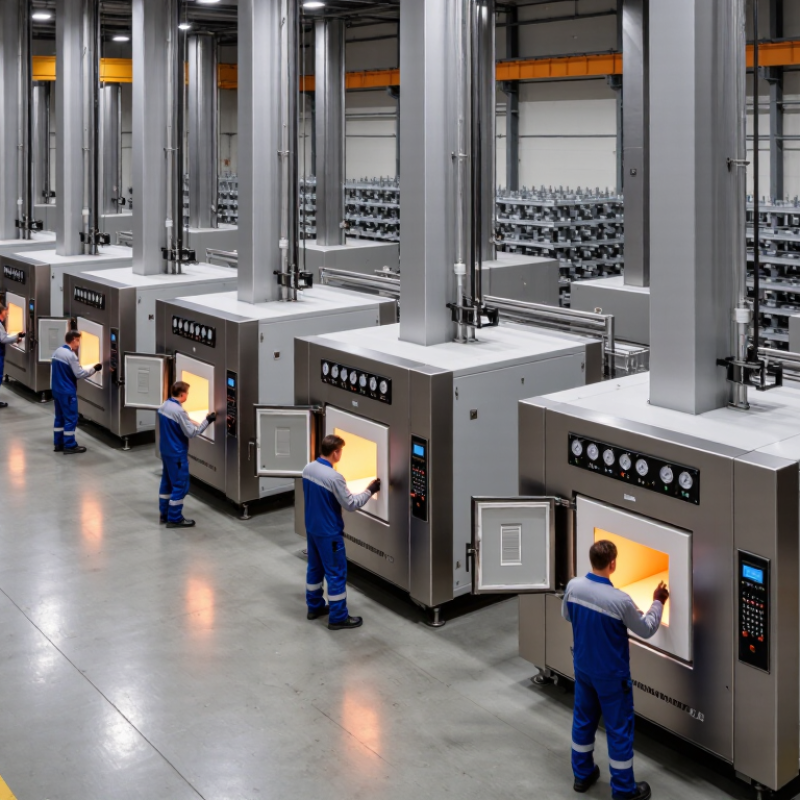
Hardening Ovens: Purpose, Design, and Industrial Applications
Hardening ovens heat steel and other alloys to controlled temperatures before quenching or tempering. This cycle changes hardness, strength, wear resistance, and dimensional stability. In practice, operators watch more than the setpoint. Load spacing, air movement, door openings, and thermocouple placement can alter results. Uniformity matters. A small hot zone can create rejected parts.
Modern designs commonly use forced convection, programmable controls, insulated chambers, and atmosphere management. Some systems connect heating, quenching, and data logging within one production line. The U.S. Department of Energy states that process heating represents about 51% of industrial energy use in the United States. Therefore, insulation, recovery cycles, and accurate temperature control affect both cost and emissions. The International Energy Agency also identifies industry as responsible for roughly 37% of global final energy consumption, reinforcing the value of efficient thermal equipment.
Applications include automotive components, cutting tools, springs, fasteners, aerospace parts, and general machinery. Buyers should examine temperature uniformity, usable chamber volume, ramp rates, cooling capability, maintenance access, and validation records. ISO 13577 provides safety guidance for industrial furnaces and associated thermal processing equipment. Yet compliance alone does not guarantee good production. A technically impressive oven may still perform poorly with uneven loading or weak operator training. That is the uncomfortable part. Equipment selection requires production trials, not only catalog comparisons. Reliable suppliers should provide test data, calibration procedures, service support, and clear limits for each material and recipe.
Key Criteria for Comparing Global Hardening Oven Manufacturers
Comparing the Top 10 Hardening Oven Manufacturers requires more than checking maximum temperature. Real production needs repeatable heat, stable airflow, and documented process control. The IEA’s Energy Technology Perspectives 2024 reports that industry uses about 37% of global final energy. Therefore, energy performance deserves equal attention. Ask manufacturers for measured kWh per batch, not only catalogue estimates. Request thermal mapping records, recovery-time data, and results from comparable loads.
Temperature uniformity is a practical test. A capable supplier should explain sensor placement, control-loop accuracy, and calibration intervals. For aerospace or automotive work, check alignment with AMS2750 and traceability to calibrated instruments. ASTM E230 provides useful guidance for thermocouple measurement. Also compare chamber insulation, exhaust design, loading ergonomics, and software records. A beautiful interface cannot repair poor airflow. That is an easy mistake.
Tips: Visit an operating installation when possible. Watch the door seal, fan noise, loading time, and operator routine. Ask for service-response times in your region, spare-parts availability, and training records. The U.S. Department of Energy’s Industrial Decarbonization Roadmap identifies process efficiency and electrification as major improvement paths. Still, efficiency claims can be incomplete. Compare identical batch weights, cycle temperatures, and production hours. I would also score warranty terms and validation support. The cheapest quotation may become expensive after one unstable cycle. Missing data should reduce the supplier’s score, even when the brochure looks convincing.
Top 10 Hardening Oven Manufacturers and Their Core Strengths
The top ten hardening oven manufacturers differ more by engineering focus than by appearance. A German specialist may lead in temperature uniformity, while an Italian builder often emphasizes compact production lines. A North American supplier may offer strong furnace controls and documented process records. Some Asian manufacturers stand out for competitive pricing, rapid customization, and practical maintenance access. Others focus on vacuum systems, protective atmospheres, or heavy-load chambers for automotive and toolmaking plants.
Buyer evaluations should examine the details behind the brochure. Look for temperature stability within ±5°C, programmable recipes, insulated doors, and clear alarm records. A reliable manufacturer should provide material certificates, factory testing, installation guidance, and responsive service after delivery. During factory audits, experienced engineers also inspect thermocouple placement, airflow around loaded trays, and recovery time after door opening. Small weaknesses matter. A polished touchscreen cannot repair poor insulation. One overlooked issue is spare-part availability, especially for heating elements and control sensors. Ask for realistic lead times, not optimistic promises. The strongest suppliers combine thermal expertise, operator safety, energy awareness, and measurable quality data. Their core strength is not merely building a hot chamber. It is helping the oven produce repeatable hardness across every batch.
Top 10 Hardening Oven Manufacturers for Global Buyers - Top 10 Hardening Oven Manufacturers and Their Core Strengths
| Rank | Supplier Profile | Primary Market Focus | Typical Oven Type | Typical Operating Temperature | Typical Working Capacity | Atmosphere and Process Control | Core Strength | Best Fit for Global Buyers |
|---|---|---|---|---|---|---|---|---|
| 1 | Supplier Profile A | Automotive and industrial components | Batch hardening oven with quench integration | Up to approximately 1,200°C | From laboratory loads to several tonnes per batch | Programmable recipes, nitrogen or endothermic gas options, multi-zone temperature control | High repeatability and complete heat-treatment line integration | Large-volume production facilities requiring automated material handling |
| 2 | Supplier Profile B | Tool steel and high-speed steel | Vacuum hardening furnace | Approximately 1,000–1,350°C | Approximately 50–1,500 kg per batch | Vacuum levels commonly below 10-2 mbar; gas quenching available | Clean surfaces, low oxidation, and controlled distortion | Precision tooling, moulds, dies, and aerospace-grade components |
| 3 | Supplier Profile C | General metalworking and job shops | Electric box-type hardening oven | Approximately 600–1,200°C | Approximately 100–2,000 kg per batch | PID control, thermocouple feedback, air circulation, optional protective gas | Flexible configuration and comparatively simple maintenance | Small and medium-sized plants seeking dependable general-purpose equipment |
| 4 | Supplier Profile D | Continuous fastener and automotive production | Continuous belt hardening and tempering line | Approximately 500–1,100°C | Commonly 100–1,000 kg per hour, depending on part size | Controlled carbon potential, belt-speed adjustment, oil or salt quenching | High throughput and consistent treatment of small components | High-volume lines producing bolts, gears, bearings, and similar parts |
| 5 | Supplier Profile E | Aerospace and high-value alloy components | Vacuum oil-quench or high-pressure gas-quench furnace | Approximately 1,000–1,350°C | Approximately 100–3,000 kg per batch | Vacuum processing, high-pressure inert-gas cooling, data logging | Traceability, uniform cooling, and process qualification support | Regulated industries requiring documented and repeatable thermal cycles |
| 6 | Supplier Profile F | Energy-efficient industrial heat treatment | Gas-fired or electrically heated batch furnace | Approximately 500–1,100°C | Approximately 200–5,000 kg per batch | Combustion monitoring or electric power control; optional atmosphere systems | Reduced operating cost and scalable chamber dimensions | Factories prioritizing energy management and large working volumes |
| 7 | Supplier Profile G | Laboratories, universities, and pilot production | Compact laboratory hardening oven | Approximately 300–1,200°C | Approximately 5–100 kg per batch | Digital programming, programmable ramp rates, optional inert-gas inlet | Compact footprint, fast setup, and accurate small-load testing | Research, sampling, prototyping, and metallurgical development |
| 8 | Supplier Profile H | Long products, bars, and heavy forgings | Walking-beam or car-bottom hardening furnace | Approximately 600–1,100°C | Several tonnes to more than 20 tonnes per batch | Multi-zone control, controlled loading, water or polymer quench options | Heavy-load handling and uniform heating of large workpieces | Steel mills, forging plants, and manufacturers of large industrial parts |
| 9 | Supplier Profile I | Gear, bearing, and transmission components | Carburizing and hardening furnace line | Approximately 800–980°C for carburizing | Typically 100–1,500 kg per batch | Carbon-potential control, sealed-quench capability, automated recipe management | Reliable case depth and surface-hardness control | Precision transmission parts requiring wear resistance and fatigue strength |
| 10 | Supplier Profile J | Custom engineering and retrofit projects | Turnkey modular heat-treatment system | Approximately 300–1,300°C, depending on configuration | Designed to order from small batches to industrial loads | PLC or industrial computer control, remote diagnostics, optional MES connectivity | Customization, integration with existing equipment, and lifecycle support | Buyers needing non-standard dimensions, automation, or plant modernization |
How to Assess Oven Capacity, Controls, Safety, and Energy Efficiency
When comparing hardening oven manufacturers, global buyers should assess working capacity, not only chamber dimensions. A 2,000-liter oven may hold far less after racks, airflow gaps, and product fixtures are installed. Ask for the usable load weight, temperature uniformity data, heat-up time, and recovery time after loading. A trial with your actual parts is more reliable than a brochure.
Controls should make production repeatable. Look for recipe storage, password permissions, alarm history, calibration records, and clear temperature graphs. Independent sensors can verify the control probe. Safety deserves equal attention. Door interlocks, over-temperature protection, emergency stops, guarded heating elements, and controlled exhaust should be tested during acceptance. Ask how faults appear on the screen. Confusing alarms can delay a safe response.
Energy performance requires measured evidence. Request kilowatt-hours per batch at a defined load, rather than relying on efficiency claims. Tight door seals, insulated panels, variable-speed fans, and low-power standby modes can reduce waste. Heat recovery may help, but only when exhaust conditions permit it. A larger oven is not automatically better. I have seen oversized chambers consume more energy while producing uneven results. Review service access, spare-part availability, training, and remote diagnostics before purchasing. Documentation should identify test methods, sensor accuracy, and maintenance intervals. Some specifications still look impressive but lack operating context. That gap deserves careful questioning.
Choosing the Right Hardening Oven Manufacturer for Your Facility
Selecting from the top ten hardening oven manufacturers requires more than comparing purchase prices. Your material, part size, production rhythm, and heat-treatment recipe should guide the decision. A manufacturer should explain temperature uniformity, atmosphere control, loading capacity, and cooling performance with measurable data. Ask for test results, not broad claims.
Visit the supplier’s reference installations when possible. Look for clean control panels, protected heating elements, and clear maintenance access. A reliable manufacturer provides calibration records, operating manuals, spare-parts guidance, and responsive technical support. Documentation should also address electrical safety and compliance requirements in your destination market. These details matter when production cannot wait for overseas assistance.
I once focused too heavily on oven capacity. That choice looked efficient, but the chamber design created uneven airflow around dense loads. The spreadsheet was right. The process was not. Request a sample-load trial using your actual baskets, fixtures, and workpieces. Check temperature mapping at several points, cycle repeatability, energy use, and operator training. Ask how the controls handle alarms and recipe changes. Simple controls are often safer, but overly basic systems may limit future production. A strong manufacturer will discuss these trade-offs openly, including weaknesses, instead of promising a perfect solution.