China Top 10 Steel Metal Channel Manufacturers
Choosing a Steel Metal Channel supplier in China is not only a price exercise. These profiles appear in building frames, equipment supports, racks, and many other fabricated structures. Their performance depends on more than a clean surface or a low quotation. Steel grade, section dimensions, wall thickness, straightness, and production consistency all deserve attention.
Small differences matter. A channel that arrives slightly twisted can slow cutting, drilling, or assembly on site. Buyers should compare technical specifications, available finishes, sample inspection options, production capacity, and delivery terms. Ask how dimensions are checked and whether inspection records can be shared. Clear answers are useful; vague assurances are not. Good documentation helps. So does direct communication.
This overview introduces ten China-based manufacturers for buyers researching steel channel supply. It considers product range, manufacturing capability, quality controls, customization, and export support, while recognizing that specifications and services can change. Some manufacturers may focus on standard sections and repeat orders. Others may offer tailored sizes or additional processing. Neither approach is automatically better. The right fit depends on the project, drawings, order volume, and required delivery schedule.
A careful comparison should confirm current details with each supplier. Review drawings, verify material and tolerances, and clarify packaging before placing an order. A polished catalog is only a starting point. Real evaluation takes more work. This guide aims to make that research more practical, while acknowledging that no shortlist can replace project-specific checks.
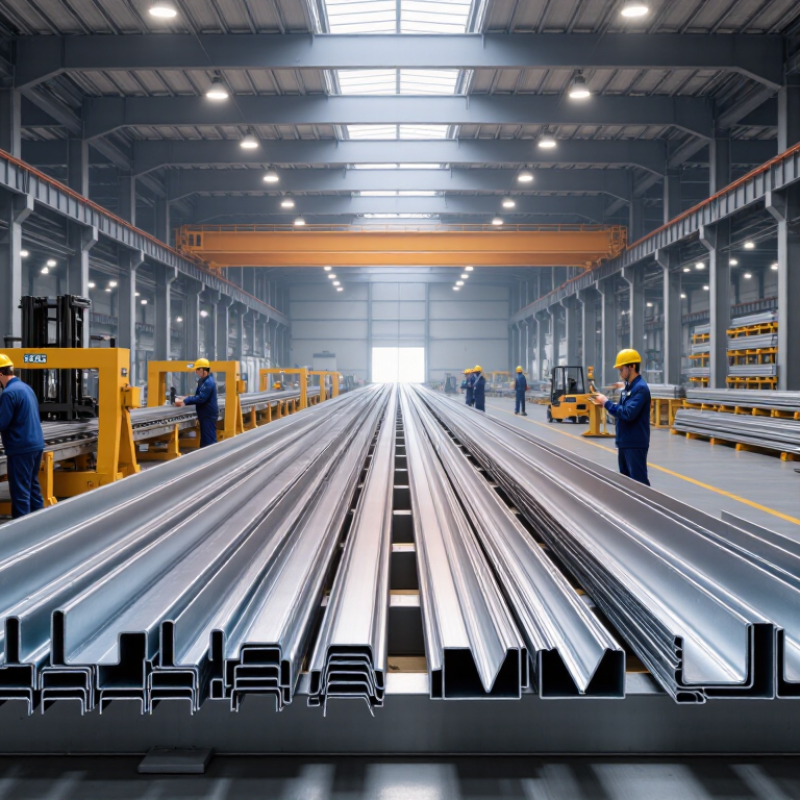
Understanding Steel Metal Channels and Their Main Types
Steel metal channels are long sections with a web and one or two flanges, formed by rolling or bending steel. Their open profiles provide useful stiffness without enclosing the whole section. Look at the cut end: a C channel has a central web and two short lips, while a U channel usually has simpler, more nearly parallel sides. Names can vary by region and supplier.
C and U channels suit framing, edge supports, equipment bases, and light structural work, depending on their dimensions and loads. Hat channels have a raised crown and two outward legs; they often support panels or create shallow furring spaces. Strut channels have a slot along the face for adjustable fittings. Handy, but not magic. Slot geometry and wall thickness affect connection strength.
Selection begins with the load, span, and fixing method. Check section depth, flange width, thickness, steel grade, coating, and drawing tolerances. A deeper channel may resist bending better, yet its open shape can twist if poorly braced. That detail is easy to miss. Corrosion exposure matters too: a dry indoor frame and a damp exterior assembly need different protection. Catalog dimensions alone cannot establish suitability; confirm the design with a qualified engineer.
Criteria for Selecting Leading Chinese Manufacturers
Selecting a Chinese steel metal channel manufacturer begins with the project specification, not the catalogue. Define the channel profile, steel grade, dimensions, tolerances, and surface finish. Then ask suppliers to match these requirements to GB/T, ASTM, or EN standards. Small deviations matter. A few millimetres can complicate assembly on site.
Production scale alone is not proof of reliability. World Steel Association’s World Steel in Figures 2025 reports China produced 1,005.1 million tonnes of crude steel in 2024, about 53% of global output. The OECD’s Steel Outlook 2025 projects global excess capacity could reach 721 million tonnes by 2027. In a crowded market, compare documented quality controls, not just price. Request recent mill test certificates, heat-number traceability, and evidence of tensile, chemical-composition, and coating-thickness checks. Check whether sample bundles match the final production batch. Ask about lead times, packing, and how the supplier handles nonconforming sections. A polished brochure proves little. I would still verify claims through an independent inspection when tolerances are tight; that adds cost, but skipping it can be the costlier mistake.
China’s Steel Channel Manufacturers: Selection Criteria
Suggested evaluation weights for comparing manufacturers. These percentages are a practical selection framework, not survey results or ratings of specific companies.
Prioritize product quality and standards compliance, then assess production capacity, delivery reliability, customization, pricing, and after-sales support. Verify each supplier’s claims with documentation and sample inspections.
China’s Top 10 Steel Metal Channel Manufacturers
China’s Top 10 Steel Metal Channel Manufacturers are best compared by capability, not by a ranking alone. Buyers should check channel dimensions, steel grades, and production tolerances against their drawings. A sample flange should sit flat, with no obvious twist or rough, uneven edges. Details matter.
A useful comparison includes product range, monthly capacity, inspection methods, and export experience. Ask whether channels are roll-formed or hot-rolled, since the process can affect section consistency and surface finish. Request recent inspection records and confirm how length, thickness, and coating are measured. Not every mill excels in every category.
Delivery reliability deserves equal attention. A supplier may offer attractive pricing, yet unclear packing details can lead to damaged edges during transport. Review bundle protection, labeling, and lead-time commitments before placing an order. These checks do not guarantee a smooth project, and specifications can still be misunderstood. That risk is real. A careful shortlist of ten Chinese manufacturers should therefore compare verified documents, sample quality, communication, and stated production limits, rather than relying on promotional claims.
China Top 10 Steel Metal Channel Manufacturers - China’s Top 10 Steel Metal Channel Manufacturers
Steel channel product and standard reference table. Entries are not a verified company ranking.
| No. | Channel Product or Reference | Relevant Standard | Typical Material Grades | What the Reference Covers |
| 1 | Hot-rolled UPN channels | EN 10365 | Grades are specified separately, commonly under EN 10025-2 | Dimensions and mass per metre for European hot-rolled channel sections. |
| 2 | Hot-rolled UPE channels | EN 10365 | Grades are specified separately, commonly under EN 10025-2 | Dimensions and mass per metre for parallel-flange European channel sections. |
| 3 | Structural steel channels to ASTM shapes | ASTM A6/A6M | Grade depends on the product specification, such as ASTM A36 or ASTM A572/A572M | General requirements for structural steel shapes, including dimensions, tolerances, and delivery requirements. |
| 4 | Carbon structural steel channels | ASTM A36/A36M | A36 | Mechanical and chemical requirements for carbon structural steel; confirm shape availability with the supplier. |
| 5 | High-strength low-alloy structural channels | ASTM A572/A572M | A572 Grade 50 is a commonly specified option | Requirements for HSLA structural steel; the selected grade and shape availability should be confirmed on the order. |
| 6 | European structural steel channels | EN 10025-2 | S235JR, S275JR, S355JR | Technical delivery conditions and grade requirements for non-alloy structural steels; dimensions are addressed by the relevant section standard. |
| 7 | Japanese hot-rolled channel sections | JIS G 3192 | Material grades are specified separately, for example under JIS G 3101 | Dimensions, mass, and permissible variations for hot-rolled steel sections. |
| 8 | Japanese general structural rolled steel channels | JIS G 3101 | SS400, among other listed grades | Material requirements for general structural rolled steel; channel dimensions are covered by the applicable section standard. |
| 9 | Chinese hot-rolled channel sections | GB/T 706 | Material grades are specified separately, for example under GB/T 700 or GB/T 1591 | Dimensions, shape, mass, and permissible deviations for hot-rolled section steel, including channel sections. |
| 10 | Indian hot-rolled channel sections | IS 808 | Material grades are specified separately, commonly under IS 2062 | Dimensions and mass of hot-rolled steel beam, column, channel, and angle sections. |
Note: Applicable standards, grade availability, dimensions, and certification should be verified against the current standard and the supplier’s mill test certificate.
Applications and Factors to Consider When Choosing a Supplier
Steel channels appear in machine bases, warehouse racks, building frames, and equipment supports. Their open profile can reduce weight while providing useful stiffness, but performance depends on orientation, span, and load. A channel used indoors may need only a standard protective finish. One installed near moisture or chemical splashes may require a more suitable coating and regular inspection.
Supplier selection should begin with the drawing and service conditions. Confirm steel grade, section dimensions, wall thickness, straightness, and length tolerances. Ask how the supplier checks these features and whether inspection records or material certificates are available. Small dimensional differences can complicate assembly. Fit matters. Sample pieces can reveal burrs, twists, or coating issues before a large order is placed.
Also review production capacity, lead times, packaging, and the supplier’s ability to maintain consistent batches. Protective wrapping matters when channels travel through wet or dusty routes. Clear answers are useful. Vague promises are not. Still, documents cannot prove how every piece will perform in your exact structure; installation quality and loading conditions matter too. A site engineer should verify the design, especially where channels carry significant loads or face vibration.

